Showing posts with label 6mm. Show all posts

Friday, 3 March 2017

That's a lot of horse flesh

I didn't like the basing on my cavalry figures (4 on a 40mm x 20mm base), as they were. I was able to use about only half of what I have painted in my Blucher games (my preferred Napoleonic rule set) also 8 figures to a unit was somewhat anaemic looking. My first thought was re-base just some figures on 20mmx20mm bases and add make new cavalry sabot to hold the 60mmx 40mm cavalry units, then thought to my self why not just re-base them all on bases the same size as my infantry and I can then use my infantry sabot for both my cavalry and infantry units.

Here is the end result of 5 days.

All my painted cavalry.

British and Portuguese cavalry

Austrian cavalry

Finally the French cavalry

I still cant use it all though. When I originally started (with Napoleon's Battle) my main cavalry unit size was 16 figures and I am using just 12 for Blucher, but still looks better than 8.


Old based cavalry in cavalry sabot
New based cavalry in infantry sabot

Gratuitous close up
 While I was taking the pictures I decided to see if there is any difference in the quality of my painting. One of the units below I painted 25+ years ago and the other one a mere 2 years ago.


Tuesday, 10 January 2017

A near run thing at HRGG

Last Saturday saw another Blucher game take place at the Hamilton Road Gaming Group, located in the Crouch Branch of the London Public Library.
The players were Cecil (Craufurd), Mike (Hill) Jordan (Ney) and I (Drouot)
A battle using two 305 point armies using the 100 days lists.

Both sides split their armies into 2 all infantry corps and an all cavalry corps. The British attached all eleven of their foot batteries to brigades, opting for the additional die when shooting, but massed their 3 horse batteries and attached it to the Cavalry corps. 

The French attached a cavalry brigade to each of their infantry corps and massed all their artillery into 2 Horse, 2 Heavy and 3 Foot units.

Both sides had an army morale of 6.

The British set up with their cavalry on their right, Craufurd's corps on the hill and Hill's corps behind the woods on the British Left.
The French set up their cavalry corps on their Left, I Corps with Drouot attached in the middle and Ney's II corps on the right.
Stars represent the objectives
Ney sent II corps forward over the hill at Hill. French I corps occupies the village and sends 3 more brigades forward to fix in place (and reveal) the British on the hill.

The entire British cavalry corps races into the center to threaten Ney's open flank, its horse battery opens fire and scores 3 hits.
II corps advances on the far side of the stream and the British cavalry rushes to threaten their flank. in the foreground French Heavy artillery opens fire on Craufurd's troops.
The French heavy batteries open fire on the British on the hill, causing some casualties, the French Cavalry corps waits in reserve.

Ney's lead brigade takes 2 more hits from the British Horse battery (they are down to 1 elan), Ney Swoops in to rally them, does and dies! (it's turn 5).
The death of Ney
Hill and Ney exchange fire for a few turns, with II corps coming off worse. Its actions only manage to fatigue only 1 British brigade, which cravenly retires. At one point Ney's successor got his cavalry behind the Hill's front line and charged a unit in the rear, with an infantry brigade flanking it as well, but was unable to break it, and the cavalry ended up retreating off the opponents table edge (counting as broken).

French I corps engages in a firefight with the Craufurd's troops on the hill, while Ney's successor fights both Hill's II corps and the British cavalry corps.

Ney's corps eventually gets ground up having 4 units Broken (counting the cavalry that left the table) and many units sitting at 2 or 3 elan, but drawing all the enemy cavalry to the far side of the battlefield, at which point the French cavalry corps goes into action, moving onto the flank of Craufurd's corps, which forms squares, and the French Artillery gets to work softening them up and cavalry charge them, quickly breaking 5 units in three turns.

On the far side of the British cavalry make another attempt to break some of Ney's troops but a series of bad rolls for the British see no French units lose a single combat.

Both side are sitting at 5 units broken.

Craufurd's surviving brigade falls back towards the Northern ford, looking to join with Hill, but a French cavalry brigade forces them to square. Five French batteries open fire on him, the first 4 (15 or so dice) and do a total of 1 hit, then a horse battery, barely in range, open fires with 4 dice and gets 3 hits (three 6's and a 2) breaking him.
The open spot just in front of the French Cavalry is where Craufurd's last brigade was destroyed by the fire of 5 massed batteries.
The British army has 6 units broken (in Blucher at the end of each turn victory is checked by asking is your army Broken?), so they regardless of what they do they have lost but as the French are one unit away from breaking themselves, we decided if the British can break a French unit they will get a draw. They launch 3 Brigades of cavalry at 2 French infantry brigades (a slim chance, but a chance) the French are in squares. The don't break either one and the game ends with a French Victory.
British cavalry preparing for their last ditch attempt to deny a victory to the much detested French.
Result: Crafurd's Corps was completely destroyed, Hill's corps had 2 units retire and a bunch of casualties (General Hill died trying to unsuccessfully inspire his troops), Ney died and 5 of his Brigades followed him. Drouot did little, except attach himself to THE Horse Battery and claims it was him laying the guns that resulted in its exceptional last shot.

22 turns.
4 1/2 hours
4 Players (2 of which had never played Blucher before).

Sunday, 31 July 2016

Blucher Battle of Frischbach

The Battle of Frischbach, Southern Germany 1809, a Battle between France and her Allies vs. Austria. A fictional battle using the Blucher rules.

July 24th I ran a game for my local gaming group. When I was designing the scenario I was expecting 4 players, so I decided to use the coalition rules and each player would run a separate army. So of course 6 players showed up, which required I do a bit of on the fly adjustments, which mostly worked out well.

This game saw the first official use of my DIY battle mat.

Rather than spend a lot of time thinking of army lists, I used my force cards and drew two 200 points Austrian forces and two 250 point French forces. I actually (just) had more than enough painted units to do it (I had to proxy some French ally units, with actual French units) for a total of 37 French & Allied units and 33 Austrian units. Each army was 4 corps. Due to the cards I used to create the armies both sides were very short on cavalry, 6 per side and while the Austrians had more guns than the French, they opted to attach most of them to infantry units (as they were defending), they only had 1 massed horse battery, whereas the French had 4 massed foot batteries.

I used the Scharnhorst maps to choose a battle area, a couple of die rolls saw me using the South Germany maps with the battle centered around D3/E3. I added a road and village in D4.


The scenario was; the Austrians are defending and if the French didn't break the Austrian army's morale or capture both objectives the Austrians would win.

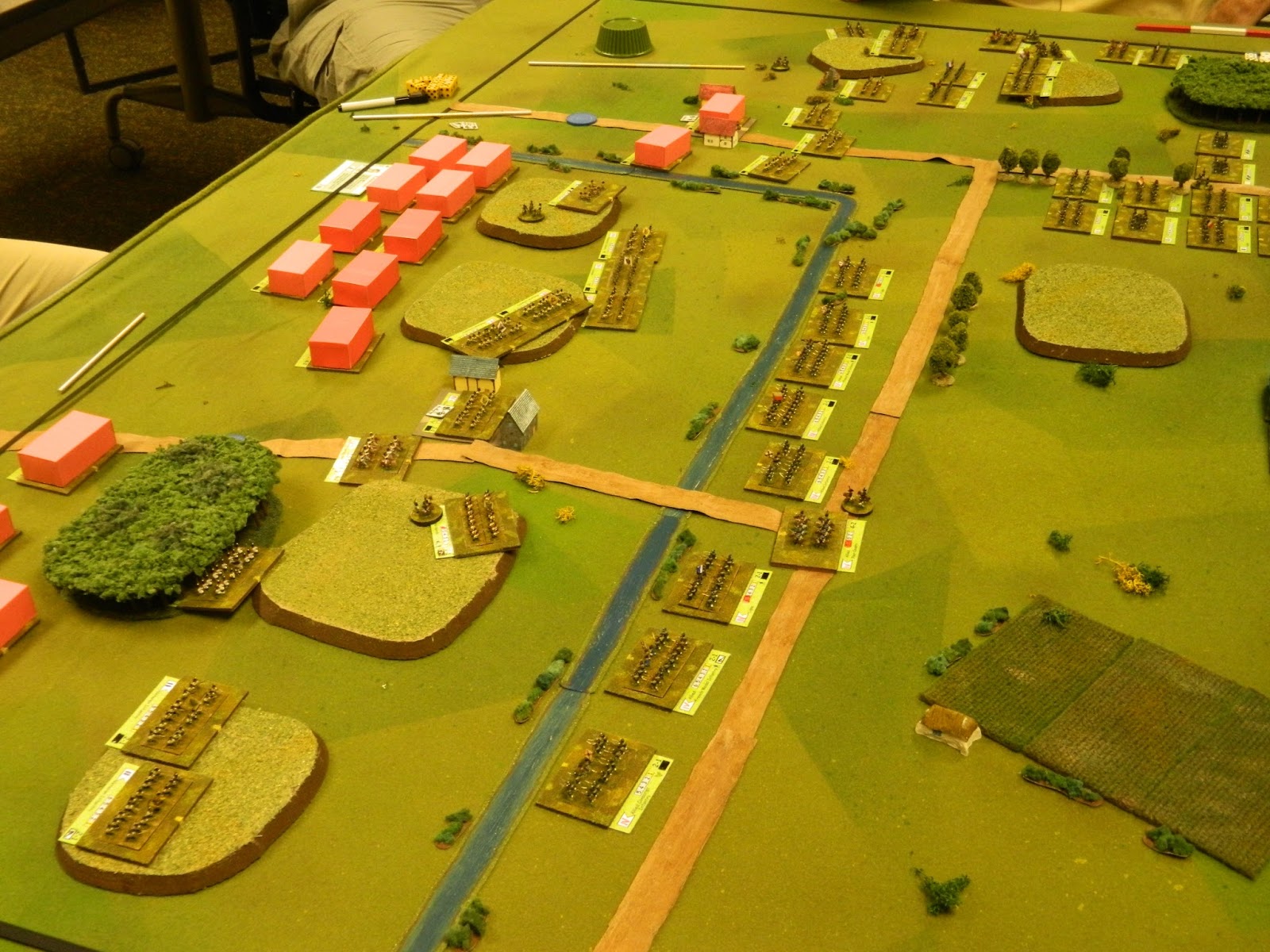
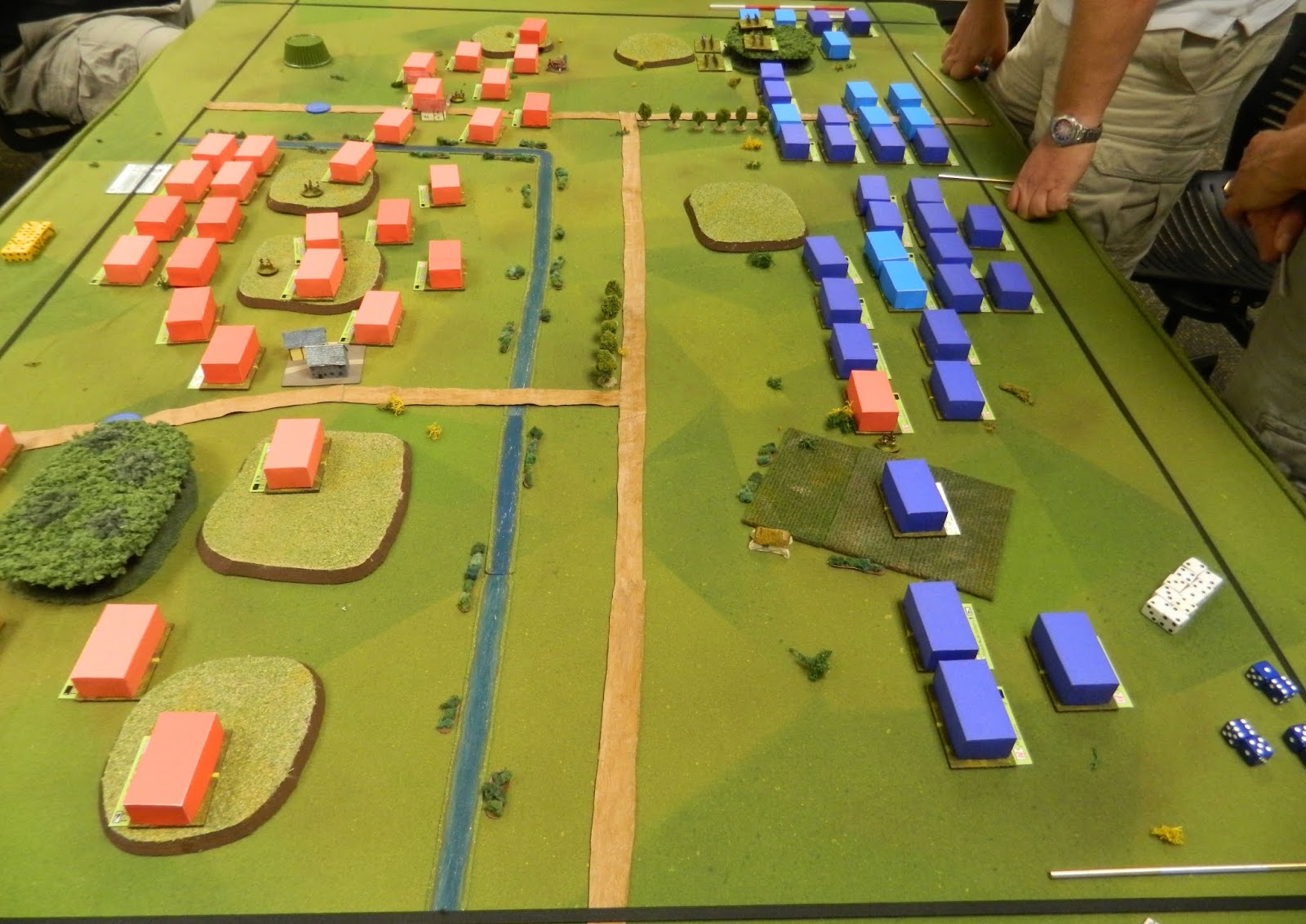
This was only the second game in which I used my Concealing boxes to show units in reserve, see Blinds Box Tutorial for additional info on them.
Setup locations French on the Right, under the Blue boxes, consider that one red box a blue box.

The Austrians deployed 3 of their 4 corps behind the stream, not realizing they couldn't use their reserve move and cross over the stream. (I guess I didn't explain it well enough)

Opening moves, the French send forward almost 2 entire corps against the lone Austrian corps.


The IV French corps, (which is mostly made of the allied units) moves to the stream and threatens to cross. The last French corps (the III) stays in reserve .


The Austrians realizing how exposed they are on their Left try to race their III Armee Korps to help.

a bit of skirmishing across the stream.

French reserves waiting for an opening.


Austrian I Armee Korps grimly holding on, the French II Corps prepares to assault the area around the village of Frischbach.

With the Austrians having little or no reserves uncommitted the French reserve launches it attack on the the Austrian center.


The fighting around Frischbach is very bloody


Fierce fighting on both sides of the stream near Frischbach.


The fighting around Frischbach dies down. The Austrians army on this side has broken and these French are beat up somewhat.

French reserves rupture the Austrian line in multiple places

The Austrian players concede the game after one wing is broken, the second Austrian wing was still in pretty good shape, but both French armies were still combat effective, albeit the I and II corps were brittle, and the French III corps had just punched 2 holes in the Austrian line

A great game and a good time had by all players. 8 Corps hammered away at each other for 5 hours and we reached an actual conclusion, as opposed to the usual "X side would have probably lost".

Wednesday, 27 July 2016

DIY Blucher unit Labels

I already have figures therefore I didn't buy the units cards, instead I made unit labels to go with my sabots. I started with a piece of paper with Corps affiliation, a box with Elan (for a die to sit on) and special abilities. It worked fine until I started moving units with dice on the labels, and got worse if the unit was on terrain.
 
First draft, I placed a die on the Elan Box.

For my second attempt I immediately decided on an Elan Track, which I would use wet or dry erase markers on, and coloured differently for each nationality.

2nd draft I went to Elan track on different coloured card stock for each Nationality.
Here are the latest (and Probably last) labels I make for my Blucher sabots. I replaced the symbols for Steady, Shock and Firepower (replaced the musket with a gun shot/explosion) because I didn't like the look of the originals. I got rid of the different colours for different nationalities, I didn't like the way the table looked with them attached. Print them on card stock, cover the front in Packing tape, so I can use wet or dry erase markers on them, also cover the back of the label in more tape, so I can re-use the labels longer, When adding the label to the sabot I just use masking tape to adhere it.

Latest draft. I fill in Corps Id and black out the attached artillery with wet erase marker and use dry erase for damage, the wet erase is difficult to erase with dry erase erasers.

For those interested and don't want to go through all the trouble I did, here is the JPG I use when I make new ones.


Wednesday, 6 July 2016

Concealing units

When I used concealed/reserve units in Blucher I made blank bases with a coloured middle which contained a number. The unit it represents is on a separate table with a numbered chit next to it. The system worked, but required that I have an additional table or a place to set the concealed units on, and you had to walk back and forth to check what base was what unit.

In the top right corner you can see my reserves precariously perched on a chair.
I had an idea, not a brilliant one, but one I could bring to fruition easily and relatively quickly.  Here is what I thought up.
What are those units?

Its a corps of Austrians!
No more needing 2 extra tables/chairs (1 for each side) and no more having to walk back and forth to see what is what, the owner can just tilt the box up to peer beneath, you can even tuck the label under the base if you want to hide it from peeking opponents. It also has 2 additional benefits, one it holds the figures into my carrying cases better and allows me to put double layer of figures in said cases.

To see how to make them go here.

6mm Rivers for Blucher

Another small post.

I have needed to make some rivers for my 6mm troops, specifically for Blucher. They will work as streams in larger scales as well.

They are made the same way as my streams, just 3" wide instead of 1".

Made this bunch out of 2 signs. 7 feet 8 inches of water obstacle,

An Austrian Corps near a ford

Thursday, 30 June 2016

DIY battle mat

I decided to do some work on my gaming tablecloth to turn it into a battle mat for my 6mm armies.

My tablecloth is a 7.5' x 5' piece of polar fleece.

Here is what it looked like.

I was hoping to make it look like a bunch of fields. I didn't want to try and paint roads, streams or wooded or rough areas, preferring to add those in with scatter terrain pieces to keep maximum flexibility for my battle mat.
Here it is after I did some painting.
How I did it; was to heavily dilute (with water and a drop of dish detergent) some dollar store acrylic paints which I then poured into a Spray bottle that creates a very fine spray (like an atomizer). Starting with my darkest green paint I placed cardboard strips to make a rectangular fields on to the fleece and sprayed inside the field templates, then moved the strips and did another until I felt I had enough. Then moved on to a lighter green, occasionally overlapping some of the other areas, then a yellow, misting it all over the cloth, allowing the paint to dry between colors, some of the fields are not rectangular and some overlap darker colors. When the fields and overall yellow were dry I adjusted my sprayer to a stream and from some distance away shot streams of tan and later burnt umber paint onto the whole tablecloth. After everything was dry I chucked it into the clothes dryer for half an hour or so (to hopefully permanently set the paint).
Close up of my DIY Battle mat
Another close up
I am pleased with how it looks, but I may do a bit more detail work (flicking paint from a toothbrush), and fill in some of the bigger empty areas.

Here is a portion of it in use during a game